A Refusal: We Will Not Give Up

Hi Friends,
Before I get to the main focus of my newsletter, I want to acknowledge the revelation of Cesar Chavez's abusive behavior and share appreciation for the swift responses believing the survivors and taking action to adjust the ways in which we have memorialized him.
And.
It is too tidy and narrow to simply add his name to the barrel of "bad apples" who should be relegated to the "dustbin of history" so that we can feel like justice has been served and we can move on from this uncomfortable feeling. As Kazu Haga recognizes, "when we push those who cause harm into the shadows, it becomes too easy for the immediate survivor of that harm as well as the broader community that is impacted by that harm to say, 'We got him. He got what was coming. We can now move on.' And that prevents us from doing the hard work of healing."
We often experience a collective desire to move past discomfort quickly and drastically, or to pretend something didn't happen at all. Even when we are able to stay in the discomfort, we are frequently reminded that accountability hasn't (yet) come for many powerful people who have acted in egregious ways. I hope that we can aspire to the model that Jennifer Rubin highlights, "The difference between a movement based on commitment to the dignity of all people and a cult of personality is that the former holds the powerful accountable, does not treat survivors as dispensable, and recognizes that any social justice movement worthy of our support is far greater than one individual."
May we continue to move towards embracing dignity and humanity, enacting restorative justice based on repair and healing so that we can build a world that can support the thriving of all of us.
A theme surfacing lately has honed in on the idea of refusal, of not giving up. Acknowledgements of Black History Month and Women's History Month culminated in Scot Nakagawa's wonderful post about how Rosa Parks, and the Montgomery Bus Boycott that followed, were not simply about seats on the bus. Instead, it was about refusal of subjugation:
"They don’t have the right to do this to us. They don’t have the right to govern without our consent, to strip our rights, to silence our voices, to dismantle the institutions that make democratic self-governance possible. We are not going to keep cooperating with a system that is dismantling democracy. We are going to refuse it. And the specific things we refuse - the seats we refuse to give up - are where we measure how far we’ve come."
Kelly Hayes followed more recently, after so many of us held our collective breaths last Tuesday, waiting to find out whether our government was going to commit further atrocities in Iran in our names. She wrote:
"People in the United States are more responsive to horror when it brushes up against us in some way. We are not unique in this regard, but we have too often had the luxury of exempting ourselves from reckoning with the damage caused by the US government and US corporations abroad. That pattern has created a social weakness fascists can exploit: yanking us around by our fears when it suits them, and battering us into moral resignation in the face of other people’s suffering. ...
"Feelings of powerlessness can be insidious. When the violence of one’s oppressor feels inevitable, when people don’t know how to stop what’s happening, the risk of moral surrender is real. Will we allow our sense of empathy to become dull and fade? Will we tune out the violence our military inflicts? Will we give up on these families and strangers overseas, who are holding hands and encircling the infrastructure that sustains their lives? Will we give up on each other, and stop defending our neighbors?"
Both of them reinforce that even in the face of powerlessness, we must not give up. We must continue to refuse, partially because feeling powerless doesn't make it true. In fact, we are more powerful than we realize. For example, Nakagawa suggests that making our movements joyful is one of the fundamental powers that we have that cannot be crushed. "If democratic resistance is joyless, exhausted, and saturated with fear, it is demonstrating - in the most visceral possible way - that the alternative to authoritarianism is grim. If our spaces feel like punishment, we are making the authoritarian’s case for them." This doesn't mean that our refusal to quit must look like toxic positivity or martyrdom or denial of difficulty. Rather, "It does not require pretending that the threats are not serious, that the losses have not been real, and that people are not tired. The refusal, in fact, requires acknowledging all of that - and then refusing anyway."
Anand Giridharadas reposted a wonderful list of ways in which we can continue to refuse to give up. He says, "The best revenge against these grifters and bigots and billionaires and bullies is to live well, richly, together. The best revenge is to refuse their values. To embody the kind of living — free, colorful, open — they want to snuff out."
Rebecca Solnit connects this refusal to give up to the very important need to resist assuming that we know what is going to happen next, whether it is with climate change or AI or the economy or political movements. We do not know what is going to happen. Certainly all of us who raised our hopes in 2016 know this deep in our bodies. She writes, "If you insist that a given outcome is inevitable, you are lobbying against resistance. At best, you've surrendered; at worst you're complicit in the outcome. ... We surrender as if to the inevitable when we turn our backs on the possible."
And rather than letting that unknown, that uncertainty make us afraid, let it give us the strength to keep working towards the possibilities of living in a world that is more just, more healthy, more accessible for all of us. Nothing is inevitable. She continues,
"History offers countless examples of those who not only did not obey in advance of whatever threat hovered over them but did not obey after threat became reality. At the heart of this country's own history are the enslaved people who refused to give up believing in their right to be free and the quest for freedom and the Indigenous people who refused over centuries to abandon their land, their rights, and their culture in the face of immense pressure to do so. The rest of us can take instruction from their tenacity."
We have ample examples and guides to help us maintain our tenacity in this fight. Erica Chenoweth has been studying movements for a long time. One of their essential findings is around nonviolence. Nakagawa reviewed their book, Civil Resistance: What Everyone Needs to Know, and shared,
"The reason nonviolent campaigns outperform violent ones is not because the universe rewards virtue. It is because nonviolent campaigns generate mass participation, and mass participation - breadth, diversity, the involvement of unlikely actors including those within the regime’s own pillars of support - is the variable that most reliably predicts success. Violence narrows that participation. It makes it easier to delegitimize and isolate a movement. It shifts the terrain from one where the movement’s strengths are assets to one where the regime’s strengths are assets. This is not pacifism. It is political realism grounded in a hundred years of data."
And I would be foolish not to include one of my favorite inspirers, Revolutionary Love and Valarie Kaur, who was interviewed by Nonviolence Radio (hosted by the Metta Center for Nonviolence, at which "we often say that the goal is not to put a different person in power, but to awaken a different kind of power in people") recently about an ethic of love in our movements. Kaur says,
"The darker it gets, the more bold we are becoming, seeing our neighbors and our families and our friends and our communities as part of us; and every time people create a space of belonging and care and respect and deep listening, anytime it’s a space where the love ethic is being practiced, I feel like I’m seeing glimpses of the world to come on the other side of all this ash. Our liberation experiments are not just like soap bubbles that pop and disappear, they are like sound waves that carry into the future. And just as I feel like I’m hearing the music of movements past, so too must we be able to lift our voices and be able to sing songs of love in such a way that future generations might hear it too. So that’s where I’m seeing it alive and well in this country."
We have seen beautiful examples of this ethic of love and nonviolence in our communities. The recent No Kings #3 protests were the largest protests in our country ever, including around 8 million people in every state and across the world. Rebecca Solnit reflected on the event, sharing that "There's fierce joy in feeling far from alone, and something magical can happen and has, again and again, when thousands of individuals feel part of a greater whole, feel the power of solidarity and the possibility that arises from it when they become civil society incarnate."
At our local No Kings #2, there were three in our group and at No Kings #3, there were six of us. Imagine if each of us brought even one more person to the next opportunity to shout in the streets and share joy at each others' clever and poignant signs and feel connected in a way that feels like a concert crowd or fans at a sporting event, a coming together of so many backgrounds and experiences around our refusal to give up, even in the face of terror from our own government.
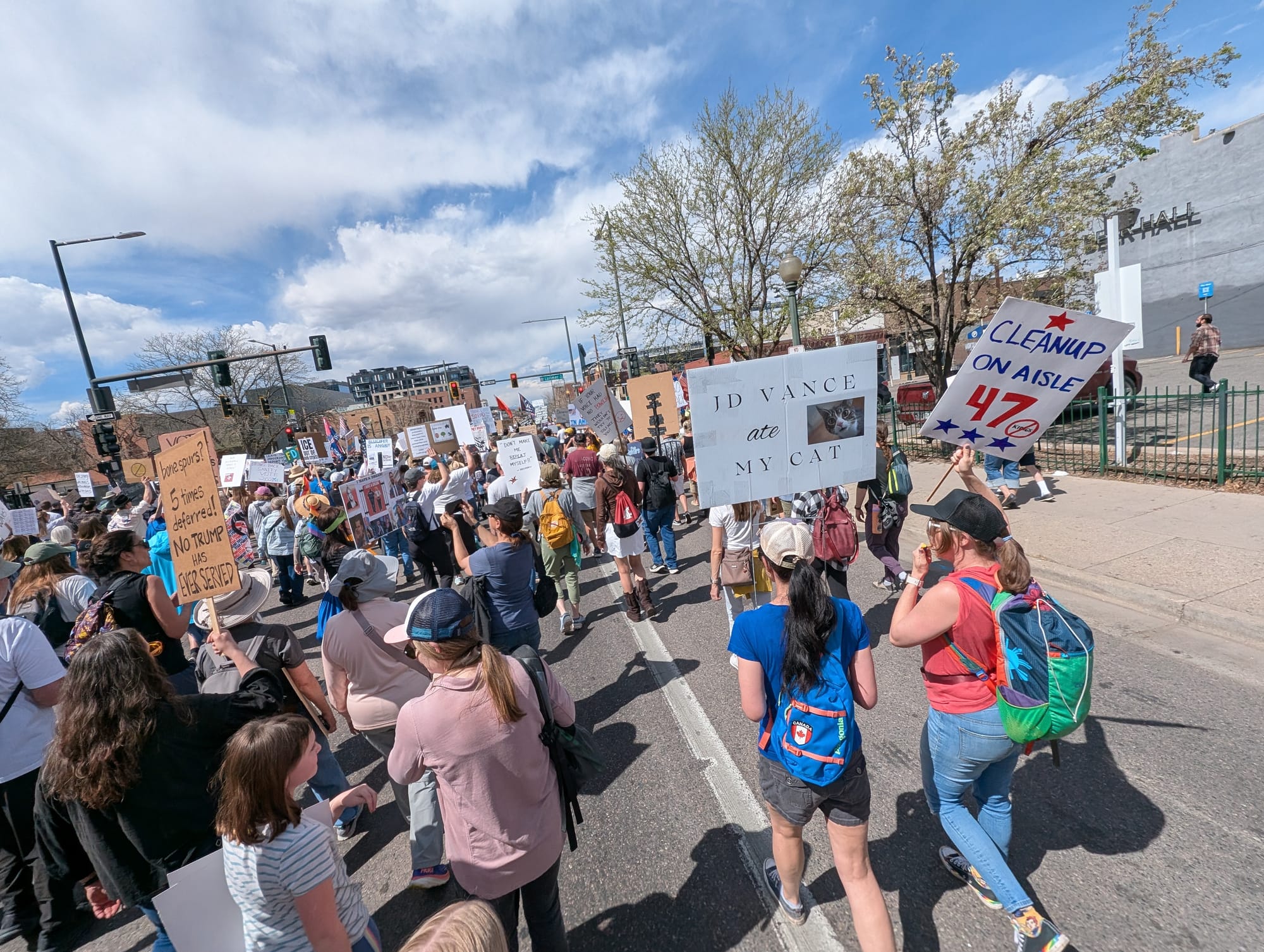
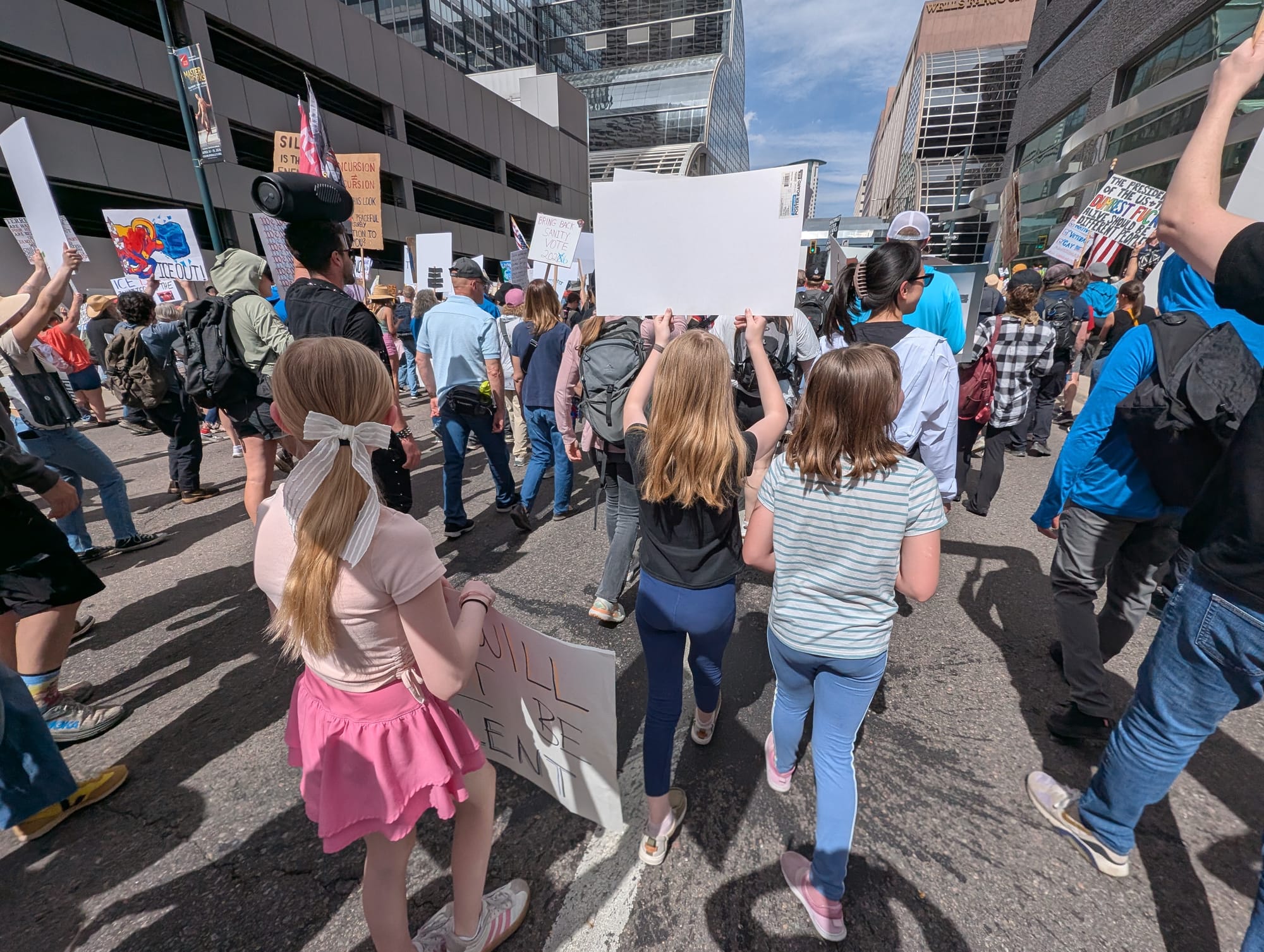
These gatherings and our refusal to give up are not simply about removing those in power from their positions. Like the bus boycott, this is not just about the seats, this is about the systems of oppression that harm all of us. For example, from Sarah van Gelder, "The same scaffolding is how we can rebuild from the damage caused by Trump 2.0, and envision a future beyond today’s ecological and societal crises. Community is also an answer to epidemic levels of loneliness and the mental health challenges of isolation, and the powerlessness that results." She continues, "Together we can free ourselves from the powerlessness that comes with living in a fragmented, capitalist society and exercise our right to envision and build the world we want to live in."
One of the often overlooked ways in which we can maintain our refusal is to read. Nicole Cardoza wrote recently about the importance of reading, noting that "This practice gives us the tools to follow extended arguments, evaluate evidence, and understand perspectives other than our own. These skills are considered foundational to informed democratic participation: readers are more likely to vote and identify misinformation on the web." She continues,
"Reading builds the capacity for empathy by requiring us to inhabit lives unlike our own. It builds the capacity for discernment by requiring us to sit with complexity long enough to understand it. It builds the capacity for imagination by giving us language for worlds that do not yet exist."
Without reading and opening our imaginations to new perspectives, we delegate many of the decisions about how we will live our lives to others. Who do we want to be making decisions about whether and how we live in our homes and communities? How can we create a better world if we cannot imagine anything beyond our own experiences?
I want to leave you with the uplifting movement of singing voices in our communities as another creative way to refuse to give up. Protest choirs! This article notes the ones in Colorado and also includes Singing Resistance, which is a national movement with local chapters. There are so many amazing new songs that have been inspired by this movement, by everyday people feeling inspired to put their feelings to song. One of the most moving for me is by Annie Schlaefer, called "We Belong to Each Other", which she says was inspired by a poem by Nikita Gill, which I am copying below:
"Every bombed village is my hometown"
-James Baldwin
And every dead child is my child
Every grieving mother is my mother.
Every crying father is my father.
Every home turned to rubble
is the home I grew up in.
Every brother carrying the remains
of his brother across borders
is my brother.
Every sister waiting for a sister
who will never come home
is my sister.
Every one of these people are ours,
Just like we are theirs.
We belong to them
and they belong to us.
--------------------
May we each find our own ways of refusal in the days, weeks, months, and years ahead, in our own private lives and in our communities. If you're looking for some ideas, please consider the upcoming May Day General Strike from May Day Strong, and/or the People's WhistleBlower Campaign. You are not alone.
Emily
Listen. Amplify. Follow. In Solidarity. I REFUSE to give up.


